Magnetic vs Adhesive Phone Grips: Which Actually Holds?
Adhesive grips hold harder and magnetic grips are more convenient, but the real decision is about how you charge and whether you carry cards on the back of your phone.
This post contains Amazon affiliate links. As an Amazon Associate we earn from qualifying purchases, at no extra cost to you.
Adhesive grips are stronger. Magnetic grips are more convenient. If that were the whole story this would be a short article, and most people would buy adhesive ones.
They do not, and the reason is that holding strength is rarely the constraint. What decides it is what else you want to put on the back of your phone, and how often you charge wirelessly.
How each one actually attaches
An adhesive grip bonds to the case with a pressure-sensitive adhesive pad. Given a clean surface and a day to cure, that bond is genuinely strong. It survives drops, hard tugs and being swung on a lanyard. It fails slowly over months as the pad picks up pocket lint and loses tack, and it fails immediately if you stuck it to a textured or silicone case that it could never grip properly in the first place.
A magnetic grip clips onto the phone's magnet ring. On a bare MagSafe iPhone, or through a case with a built-in magnet array, that hold is solid enough for one-handed scrolling and for lifting the phone off a table. It is not rated for hanging the phone off a finger and swinging it, and treating it that way is how people find out the difference.
The gap between them is real but narrower than it sounds for normal use. The question is what each one costs you.
What adhesive costs you
It is semi-permanent. Removing one leaves residue, and on a soft-touch, printed or matte case it often takes the finish with it. On a clear case the adhesive pad is visible from the front edge as a grey disc, which people find uglier than they expect.
It blocks wireless charging if you centre it, because the charging coil sits in the upper middle of the back. There is a workaround, covered in do phone grips block wireless charging: stick it low, in the bottom third, outside the coil area. You keep charging and give up a little comfort.
And it is tied to one case. Change your case and you either buy another grip or perform surgery on the old one.
What magnetic costs you
It occupies the magnet ring, and that ring is contested. A magnetic grip means no MagSafe wallet in the same spot, no magnetic charger without removing it, and no magnetic car mount without removing it. We work through that in can you use a MagSafe wallet and grip together.
It also depends entirely on your phone and case having magnets. On a phone without a magnet array, including the iPhone 16e, a magnetic grip does nothing at all until you add a case with a ring. And through a thick case without an array, holding force drops enough that the grip starts creeping under its own weight.
The upside is that it is reversible in every sense. Wrong grip, wrong case, want a wallet today instead, all solved in a second with no residue and no regret.
The decision, honestly
The useful way to choose is to answer two questions rather than compare specifications.
How do you charge? Cable overnight means a magnetic grip costs you nothing. Wireless pad several times a day means a magnetic grip is a small tax you pay over and over, and a low adhesive grip is the better answer.
Do you carry cards on your phone? If you use a MagSafe wallet, a magnetic grip is not an option, because they want the same spot. Either commit to a low adhesive grip and keep the wallet, or give up the wallet.
If neither question decides it, buy magnetic. It is the reversible choice, and reversible beats optimal when you are not sure.
Phone size changes the answer
A grip is a convenience on a 6.1-inch phone and close to a necessity on a 6.9-inch one.
The mechanism is balance rather than friction. Holding a large phone by its edges puts your thumb at full stretch to reach the top corners, and the phone wants to rotate out of your hand as you reach. A grip moves the support point to the middle of the back so your fingers carry the phone and your thumb is free to work.
That also affects which type to buy. On a big phone the grip does structural work, so the stronger bond of an adhesive pad is worth more. On a small phone a magnetic grip is plenty.
What about the case underneath
Both types depend on the case more than on the grip.
Adhesive needs a smooth, hard surface. Silicone, soft-touch and heavily textured cases are poor substrates, and a grip that seems fine on day one peels off in a fortnight.
Magnetic needs magnets. A case with a built-in array holds a grip almost as well as a bare phone. A plain case adds distance and weakens everything. Our guides for the iPhone 16 family and the 17 Pro Max flag which picks have real arrays, and why MagSafe accessories fall off explains how steeply that distance penalty bites.
Frequently asked questions
Are magnetic grips strong enough to hold a phone safely? For one-handed use and lifting the phone off a table, yes. They are not rated for dangling or swinging the phone, and they detach under a sharp sideways pull. Adhesive grips survive that treatment and magnetic ones do not.
Do adhesive grips damage phone cases? Often. Removing one leaves residue and can pull the finish off soft-touch, matte or printed cases. On clear cases the adhesive pad is visible from the edge.
Will an adhesive grip stick to a silicone case? Usually not for long. Silicone, soft-touch and textured surfaces give the adhesive nothing to bond to. Smooth hard plastic is what these pads are designed for.
Can I use a magnetic grip on an iPhone without MagSafe? Not directly. Phones with no magnet array, including the iPhone 16e, need a case with a built-in magnet ring before any magnetic accessory will hold.
Which type is better for a large phone? Adhesive, if you can live with the trade-offs. On a 6.9-inch phone the grip carries real weight and the stronger bond matters more than it does on a small phone.
Can I switch from adhesive to magnetic later? Yes, but not cleanly. The adhesive pad has to come off, it will leave residue, and the case it was stuck to may not survive looking new.
More reviews
Will iPhone 17 Cases Fit the iPhone 18 Pro?
They are within two hundredths of an inch of each other in height and width, which is exactly why people try it. Here is what Apple's own numbers say and what goes wrong.
Read the review→Does the iPhone 17e Have MagSafe? Yes, Unlike the 16e
Apple quietly fixed the biggest accessory complaint about its budget iPhone. The 17e has a real magnet array, which changes what you need to buy alongside it.
Read the review→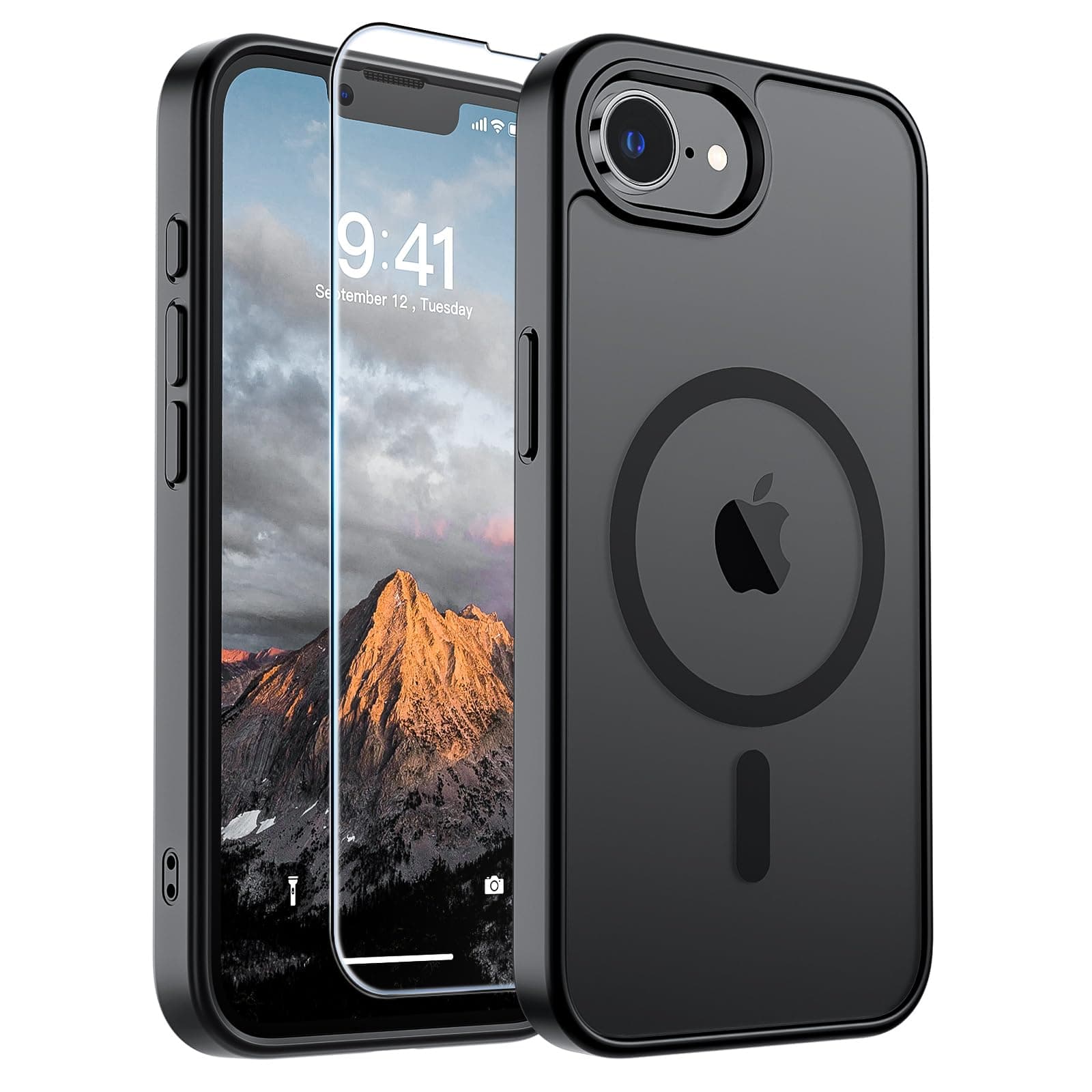 Review
Best iPhone 16e Cases With Built-In MagSafe Magnets
The 16e has no magnets of its own, so the case decides whether wallets, mounts and magnetic chargers work at all. Four picks that carry a real magnet array, from under $7 to just over $30.
Read the review→